

The modern marketing landscape is currently experiencing a profound reckoning.
Organizations that rushed to adopt generative AI in a siloed, ad-hoc fashion are finding themselves trapped by the “Content Paradox”: the ability to generate infinite volume often results in a rapid decline in quality, brand equity, and engagement.
According to industry data, the vast majority of AI-driven content initiatives struggle to move beyond the experimental phase, frequently failing due to a lack of structural maturity.
To escape this trap, marketing leaders must stop viewing artificial intelligence as a collection of standalone writing tools and begin architecting comprehensive, AI-driven media pipelines.
By transitioning from “prompting” to “content engineering,” businesses can finally turn content production into a scalable, high-velocity Go-To-Market (GTM) engine.
Moving Beyond the Prompt: The Shift to Content Systems Thinking
The Content Scaling Paradox: Why Volume Often Destroys Quality
The allure of AI lies in its velocity, but uncontrolled speed is the enemy of strategy.
When content teams treat AI solely as a tool to churn out more words, they suffer from semantic drift—where the brand voice becomes diluted, factual inaccuracies multiply, and SEO relevance plummets.
Volume is only an asset if it maintains a specific standard of utility.
Scaling without governance results in a flooded inbox and a confused audience, ultimately damaging brand authority rather than bolstering it.
From AI Tools to AI-Driven Media Pipelines: A Paradigm Shift
Moving beyond basic AI tools requires a structural shift toward the media pipeline.
In this model, individual AI models are nodes in a larger, interconnected workflow.
This is not about choosing the “best” chatbot; it is about orchestrating multiple agents to perform specific, repeatable tasks.
By replacing manual, disconnected processes with an integrated pipeline, teams can ensure that every piece of content, from complex white papers to nuanced product descriptions, adheres to the same quality logic.
The Evolution from “Manual Production” to “Content Engineering”
We must adopt the mental model of software development.
Content engineering treats the content stack like a CI/CD pipeline.
Just as code undergoes automated testing and deployment, content undergoes automated validation.
This discipline shifts the role of the creator from a manual writer to a system architect, focusing on the infrastructure that allows content to flow from concept to publication with minimal friction.
The Foundation: Modular Content and Structured Workflows
Defining the Modular Content Architecture
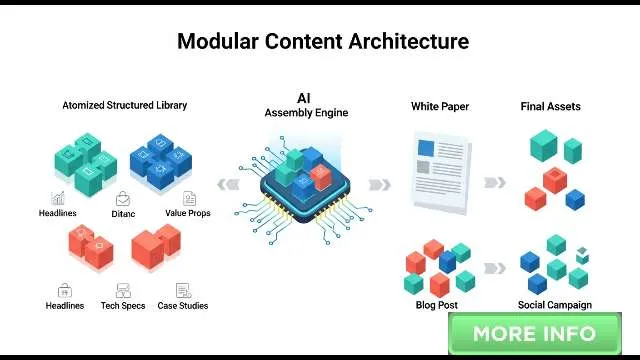
Modular content is the practice of breaking assets into reusable, atomized components—headlines, value propositions, technical specifications, and case study snippets.
Instead of crafting one-off assets, teams build a library of governed modules.
AI models then assemble these components based on the specific intent of the target audience, ensuring consistency across every touchpoint.
Implementing Schema Detection and Structured Content for AI Readiness
AI functions best when it can interpret structured data.
By implementing clear schema detection—mapping content requirements to specific metadata—organizations create “AI-ready” environments.
This structured approach allows the pipeline to automatically map keywords and intent data to content modules, ensuring that the output is not only high-quality but also optimized for the specific context of the reader.
The Role of the Content Engineer in Modern Operations
The Content Engineer is the architect of this ecosystem.
They manage the governance frameworks, ensure the pipeline remains performant, and fine-tune the orchestration logic.
Their goal is to eliminate manual “prompt gymnastics,” ensuring that the underlying systems provide the AI with the right context every single time, without the need for constant human hand-holding.
Building the Technical Infrastructure of an Enterprise-Grade Pipeline
Leveraging Retrieval-Augmented Generation (RAG) for Brand Grounding
RAG is the primary mechanism for ensuring brand consistency.
By grounding AI models in a private, vetted vector database of your own high-performing content, you prevent “hallucination.
” RAG ensures that every draft reflects your specific brand voice, unique terminology, and verified product data, serving as a permanent guardrail against generic AI output.
Moving from Single Prompts to Agentic AI Workflows
Single prompts are brittle.
Agentic workflows, by contrast, use autonomous AI agents that perform multi-step tasks.
One agent might research keywords, another drafts the outline, and a third ensures the content aligns with the style guide.
By linking these agents, the workflow becomes a resilient, self-correcting loop that produces finished assets rather than mere text drafts.
Integrating CI/CD Principles into Content Production
Applying CI/CD principles means that no content enters the “production” stage without passing automated quality controls.
Just as code is linted for errors, content is audited for brand voice, keyword coverage, and regulatory compliance.
If an asset fails these automated checks, it is routed back for refinement before it ever reaches a human editor.
Cloud Computing and MLOps: Managing Compute and Model Registries
Enterprise content operations require the same rigour as software operations.
Managing model registries—keeping track of which AI models are used for which tasks—and optimizing cloud compute usage are vital for long-term scalability.
MLOps frameworks help teams monitor the performance of their models, ensuring that the pipeline stays efficient as volume increases.
Phase 1: Intelligent Ingestion and Strategic Planning
Automating Keyword Research and Brief Generation
The process begins with intent.
By connecting platforms to search data and trend analysis, the pipeline can automatically generate content briefs based on current market demand.
This eliminates the guesswork, ensuring that every asset produced is mapped to high-value keywords and business objectives.
Integrating Intent Data and Firmographic Data for Targeted Briefs
Advanced pipelines ingest behavioral data from CRM systems to create highly personalized briefs.
By understanding if a prospect is in the middle of a buying cycle or in the research phase, the system can tailor the brief to prioritize the specific tone and information density that will move that prospect forward.
Connecting the Content Calendar to the GTM Engine
Content must be a lever for growth.
When the content calendar is integrated directly with GTM dashboards, leadership can see the immediate impact of production on sales velocity.
KPIs are no longer vanity metrics; they are tracked in real-time, allowing teams to pivot their production strategy based on what is actually influencing the sales pipeline.
Phase 2: The Generation Engine and Orchestration
Multi-Model Orchestration: Using the Right AI Tool for the Right Task
Not all AI models are created equal.
An enterprise pipeline uses multi-model orchestration to assign tasks based on strengths: one model may excel at creative long-form writing, while another is optimized for technical documentation.
Routing tasks to the appropriate model maximizes quality and performance.
Avoiding “Prompt Engineering Gymnastics” with Standardized Logic
Standardized logic eliminates the need for teams to manually “trick” the AI into being brand-compliant.
By embedding instructions into the pipeline’s system architecture, the models are pre-conditioned to adhere to style guidelines, tone, and formatting constraints by default, allowing the AI to focus on substance rather than complex prompt management.
Generating Beyond Text: Neural Rendering and Multi-modal Assets
The future of content is multi-modal.
A sophisticated pipeline doesn’t stop at text; it triggers neural rendering and image generation agents to create supporting visuals, charts, and diagrams.
This ensures that every asset is visually consistent, branded, and ready for publication across various channels without extra design cycles.
Phase 3: Governance, Brand Consistency, and Quality Controls
Automated Style Guide Enforcement and Brand Voice Validation
Governance is the difference between a brand and a commodity.
Automated tools compare every generated asset against a living style guide, flagging deviations in tone, vocabulary, or formatting.
This layer of governance acts as an “immune system” for the brand, ensuring that even at massive scale, the voice remains unmistakable.
Designing the “Human-in-the-Loop” Expert Review Layer
The expert-in-the-loop (HITL) layer is the final checkpoint.
Humans do not write the content; they curate, validate, and sign off on it.
This expert validation acts as a scalable filter.
By focusing human expertise only on the most critical strategic decisions, organizations maintain quality while offloading 90% of the production burden to the AI engine.
Maintaining an Audit Trail for Regulatory Compliance
For industries governed by strict compliance standards, an immutable audit trail is mandatory.
The pipeline must log which model generated the content, which RAG sources were referenced, and what human oversight occurred.
This documentation is essential for internal compliance and external regulatory requirements, establishing enterprise-level trust in AI-generated assets.
Phase 4: Distribution, Personalization, and Localization
Automating Localization for Global Content Delivery
Manual translation is a bottleneck.
Automated localization pipelines ensure that as soon as a core asset is approved, it is translated, culturally adapted, and formatted for international markets.
This allows a global organization to maintain a unified narrative while providing locally relevant content at unprecedented speeds.
AI-Powered Personalization: Tailoring Content to Behavioral Segmentation
Personalization is no longer about inserting a name into an email.
AI-powered systems can now dynamically re-render content modules based on the behavioral segment of the viewer.
By serving the most relevant content variation to each prospect, teams significantly increase conversion rates and decrease bounce rates across the web.
Sales Enablement: Feeding Content Directly into the Sales Pipeline
Finally, the content pipeline must feed directly into sales enablement tools.
When product descriptions, white papers, and battle cards are automatically pushed to the CRM, sales teams have instant, high-quality, and updated collateral.
This alignment turns the content team into a direct engine for sales productivity, ensuring that the right message is always in the hands of the right seller.
Conclusion
Scaling high-quality content in the age of AI requires moving past the superficial allure of individual tools and embracing the discipline of Content Engineering.
By architecting a robust, automated pipeline—from intelligent ingestion and multi-model orchestration to rigorous governance and expert-in-the-loop validation—organizations can finally achieve the elusive balance of high volume and high value.
To begin this transformation, audit your current content lifecycle for bottlenecks and manual inefficiencies.
Prioritize the implementation of RAG-based grounding to protect your brand voice, and shift your team’s focus from writing to architecture.
As you transition to an autonomous content ecosystem, your KPIs should shift from simple output metrics to business impact metrics, such as sales velocity and customer engagement.
The future of content belongs to the organizations that view their production engine as a sophisticated, integrated, and governed system.
By acting as architects rather than mere users, you position your brand to thrive in a landscape where speed and quality are no longer mutually exclusive but are instead the twin pillars of a high-performing GTM strategy.
Start building your pipeline today, and secure the scalability your brand requires for the next decade of growth.
