
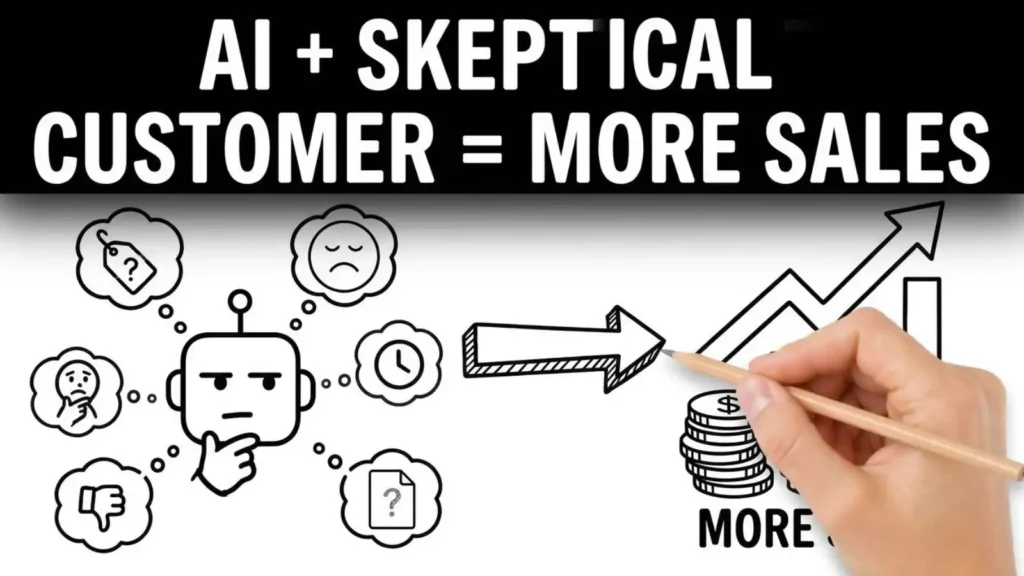
Have you ever spent weeks crafting the “perfect” sales page, only to launch to the sound of crickets?
It is one of the most frustrating experiences in business.
You know your product is valuable, and you know it can help people, but for some reason, your target audience isn’t hitting that “buy” button.
Usually, the problem isn’t your passion, it’s a lack of understanding regarding what is actually stopping your customers from committing.
To fix this, you need to stop guessing and start stress-testing.
The secret weapon?
Artificial Intelligence.
However, the goal isn’t just to have AI write your copy; it’s to get the AI to think exactly like your most skeptical prospect.
By pinpointing doubts and objections before you go live, you can transform a mediocre launch into a high-converting success story.
A skeptical AI now means significantly more sales later.
Feed the AI Your Raw Data
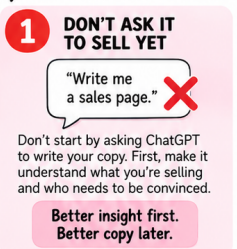
Before you ask an AI to improve your sales page, you must first ensure it has a deep, fundamental understanding of what you are actually selling.
Many people make the mistake of asking for a rewrite immediately. Instead, your first priority is to provide the AI with your actual offer in its current state.
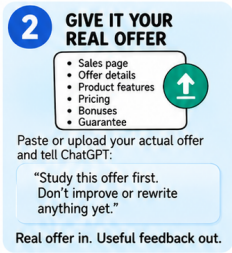
Upload everything you have: your current sales page copy, a list of product features, your pricing tiers, and all the nitty-gritty details that define your business.
Tell the AI to study this offer thoroughly. Crucially, instruct it not to improve or rewrite anything just yet.
It needs to absorb every single detail, from the fine print to the core value proposition, before it can offer any real, actionable help.
Define Your Buyer with Extreme Precision
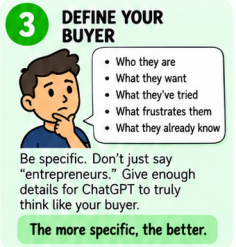
If you give an AI a generic prompt like “my target audience is entrepreneurs,” you are going to get generic results.
In the world of marketing, precision is power.
To get the most out of your AI stress test, you need to define your buyer with surgical accuracy.
Go beyond basic demographics. Ask yourself and tell the AI:
- Who are they specifically? (e.g., “SaaS founders in their first year” rather than just “business owners”)
- What do they desperately want to achieve?
- What keeps them up at night?
- What are the specific frustrations they face daily?
The more data you pour into the AI regarding your buyer’s psyche, the better it can “channel” that specific customer vibe.
When the AI knows exactly who it is supposed to be, its feedback becomes infinitely more valuable.
The Skeptical Prospect Stress Test
Once the AI understands your offer and your buyer, it’s time to flip the script. Instead of asking the AI to be your cheerleader, ask it to be your harshest critic.
Use a prompt that forces the AI to act as a real, skeptical prospect who is looking for reasons not to buy.
Try a prompt like: “Act as this potential customer. Evaluate my offer from their point of view, not mine. Be honest and do not be polite.”
This approach unearths hidden flaws fast. When you are too close to your own product, you become blind to its weaknesses.
A skeptical AI will find those “Wait, what?” moments, the parts of your sales page where a buyer might pause, feel confused, or hesitate because they need more information.
These friction points are easy to miss when you know your product inside and out, but they are fatal to your conversion rate.
Identifying Pre-Buy Questions
Ask the AI to “spill the tea” on the questions a customer might have before they are willing to pull out their credit card.
It will likely generate common but vital queries such as:
- “Does this actually work for someone in my specific niche?”
- “Is there a real guarantee if I don’t see results?”
- “How much time will I actually have to invest to see a return?”
Review Through Multiple Mindsets
Not every customer thinks the same way.
To truly bulletproof your offer, you should ask the AI to review your sales page from several different buyer mindsets.
Each viewpoint offers fresh insight that you might have otherwise overlooked.
Instruct the AI to rotate through these personas:
- The Skeptic: They’ve been burned before and think everything is a scam. They need proof and data.
- The Beginner: They are overwhelmed by jargon. They need to know if the process is simple enough for them to follow.
- The Value Hunter: They are comparing you to every competitor. They need to know why your offer is the best “bang for their buck.”
By viewing your offer through these different lenses, you will unearth a wide variety of objections, allowing you to address them all before you ever hit “publish.”
Fix the Offer, Not Just the Copy
Sometimes, the feedback you get from your AI stress test will reveal that the problem isn’t your writing, it’s the offer itself.
It is a common mistake to try and “word-smith” your way out of a bad product-market fit. Strong offers win, not just smart phrasing.
When the AI identifies major objections, ask yourself: Is this an issue with my copy, or do I need to fundamentally change the offer? You might find that you need to:
- Add a better, more relevant bonus.
- Simplify the onboarding process.
- Lower the perceived risk with a stronger guarantee.
- Adjust the pricing structure to better match the value.
Make these core changes before you launch. It is much easier to fix a structural flaw in your offer now than to try and salvage a failing campaign later.
The Formula for a High-Converting Offer
If you want to ensure your offer is as convincing as possible, follow this simple formula derived from the AI stress-testing process:
Offer + Buyer Insights + Objections + Questions + Fixes = Success
By combining your raw product details with deep buyer empathy and then filtering them through a lens of skepticism, you create a refined version of your business that is prepared for the real world.
Key Takeaways for Your Next Launch
- Don’t Rush the AI: Let it study your data before asking it to create or edit anything.
- Specificity is Everything: Generic personas lead to generic sales. Give the AI deep, psychological data about your buyer.
- Embrace the Critique: Use prompts that encourage the AI to be “impolite” and brutally honest about your flaws.
- Address the “Wait, What?” Moments: Find the friction points where buyers get confused and clear them up immediately.
- Fix the Core: If the AI finds a major hole, don’t just change the words, change the offer.
Conclusion: Flip the Script
The most important mindset shift you can make when using AI for marketing is this: Always ask the AI why customers won’t buy your product, rather than why they will.
It is easy to find reasons why your product is great, but those reasons don’t always close the deal.
Sales happen when you remove the barriers to entry. By flipping the script and focusing on the “why not,” you reveal the true areas for improvement.
Use AI to find the cracks in your armor now, and you’ll be rewarded with a much stronger, more profitable launch later.
Remember, precision, skepticism, and a willingness to fix the core offer are the keys to turning a “maybe” into a “yes.”
