
When Enrico Fermi famously asked, “Where is everybody?” regarding the search for intelligent life, he wasn’t just pondering biology; he was identifying a cosmic bottleneck.
The Fermi Paradox suggests that if the universe is teeming with potential, our lack of evidence for extraterrestrial life implies a “Great Filter”—a barrier so difficult to cross that it prevents civilizations from achieving interstellar travel.
Today, entrepreneurs are facing their own Great Filter.
In a world defined by the rapid scaling of Artificial Intelligence, the traditional value of “what you know” is effectively hitting a zero-margin ceiling.
Just as resource exhaustion or a catastrophic nuclear war might prune a species, modern markets are ruthlessly filtering out founders who rely on legacy knowledge rather than adaptive execution.
The Trap of Emotional Attachment
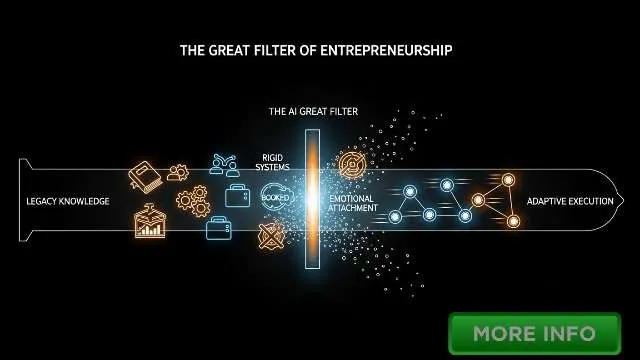
Founders often fall into a trap that mimics the history of failing civilizations: they become emotionally wedded to their “mastery” of obsolete systems.
Much like how a society might ignore the warning signs of resource exhaustion, many leaders cling to stagnant business ideas that were viable when knowledge was scarce, but are now commoditized by LLMs.
Consider the evolution of automotive engineering; the transition from the Model S to the Model 3 required more than just incremental changes—it demanded a complete shedding of the “luxury-only” mindset.
If you are emotionally tethered to how you built your product or raised Startup Funding in the past, you are essentially standing in the path of an evolutionary Chicxulub event.
True resilience isn’t found in a degree or a decade of experience, but in the ability to pivot when the ground shifts.
Organizations that fail to acknowledge this are often doomed by the “Hitler Problem”—the inability to correct a catastrophic trajectory until the nuclear arsenal of their own fixed costs has already decimated their runway.
Change is the Ultimate Filter (And Your Best Friend)
In the current ecosystem, Artificial Intelligence serves as a technological proxy for a gamma ray burst—a sudden, intense event that fundamentally reorders the playing field.
Many view this with fear, but for the agile founder, this filter is a competitive advantage.
It clears out the “knowledge-heavy” clutter.
Think of how Kincade Productions or Indigo Films navigated the shift from traditional media to Social VR Ecosystems.
The challenge wasn’t just technical; it was the Build vs buy decisions that define modern scaling.
If you look at Harvard Business Review case studies on organizational survival, you find that those who endure are those who treat their operations like a Von-Neumann probe: self-replicating, self-correcting, and constantly seeking new data points to optimize their trajectory.
By embracing the filter, you stop competing on what you know—which is easily searchable on the Stack Exchange Network or Stack Overflow—and start competing on your ability to synthesize new realities before the market settles.
The Most Valuable Skill of the Next 5 Years
The most valuable skill is no longer accumulation; it is the speed of architectural evolution.
We are entering an era of “Deep Tech” where energy, not just information, becomes the primary constraint.
Whether it’s advancing fusion power through the Z Machine and its sophisticated pulsed power systems or investing in the next generation of fusion companies, the barrier to entry has moved from the software layer to the physical layer.
Founders must possess the Executive Talent to manage high-stakes hardware R&D—the kind of work involving antimatter technology or Z STAR initiatives.
Just as Robin Kincade and Christopher Knox had to master the integration of 360 Photo Capture during the early days of Facebook Spaces, current entrepreneurs must master the integration of emerging energy and compute solutions.
The filter is moving from “who has the best information” to “who can solve the multi-planet situation and sustain complex systems.
” This is no longer a game of reading the Encyclopedia Britannica; it is a game of building the infrastructure—from energy storage to anti-aging technology—that allows humanity to survive the next epoch.
Conclusion
The “Great Filter” of entrepreneurship is not a distant, theoretical threat; it is the current reality of a market that punishes stagnation and rewards the ability to bridge the gap between abstract concepts and physical outcomes.
By moving past the obsession with credentials and focusing on iterative, high-leverage building, you can navigate the transition from a traditional enterprise to a future-proof powerhouse.
Whether you are solving the physics of fusion reactions at Sandia National Labs or building a platform for the next decade of creators, remember that your greatest defense against the filter is your capacity for transformation.
The goal is to evolve faster than the environment can constrain you.
Embrace the disruption, discard the obsolete, and build toward a future where your venture is not just surviving, but setting the pace for the next era of human progress.
