

The myth of passive income has long plagued the creative economy.
Many entrepreneurs fall into the trap of believing that a single digital product, once launched, will automatically generate wealth while they sleep.
However, the reality for successful creators is far more disciplined.
Building high-impact digital products is not a stroke of luck; it is a systematic process of engineering value.
By adopting the mindset of a professional product manager, creators can move beyond random content creation and build a sustainable, scalable business.
This guide outlines how to shift from “idea-first” thinking to a data-backed, problem-solving framework designed for long-term growth.
The Mindset Shift: Adopting a Product Management Framework
Moving from “Idea-First” to “Problem-First” Development

Most creators start with an idea: “I should create a course on productivity” or “I’ll design a pack of templates.” This is backward.
A product manager starts with the problem.
Your focus must be on the specific pain points your audience faces.
When you lead with the problem, you naturally move toward solutions that the market is already hungry for, significantly reducing the risk of a failed launch.
Why Modern Creators Need “Product Sense”

Product sense is the ability to connect user needs with technological solutions.
It requires a blend of empathy and analytical rigor.
Whether you are building an ebook or a complex software tool, you are responsible for the customer’s journey.
By applying product sense, you treat your audience not just as followers, but as users whose friction points you are uniquely positioned to solve.
The Evolution of the Digital Product Ecosystem: Beyond the PDF

The digital landscape has matured.
A static PDF no longer commands a premium price.
Modern customers expect dynamic, high-utility tools.
The ecosystem now includes interactive notion templates, gated community platforms, automated systems, and micro-SaaS tools.
This shift forces creators to elevate their design standards and technical execution, moving from mere information dissemination to genuine transformation.
Phase 1: Discovery and the Jobs-to-be-Done (JTBD) Framework
Identifying Deep Pain Points vs.
Surface-Level Inconveniences
To find profit, you must dig deep.
Surface-level inconveniences are easy to identify, but deep pain points represent the core struggles that keep your target audience awake at night.
Use the JTBD framework to ask: “What job is my customer hiring this product to do?” If your product solves a high-stakes problem, you stop competing on price and start competing on value.
Mapping the User Journey to Find Friction Points
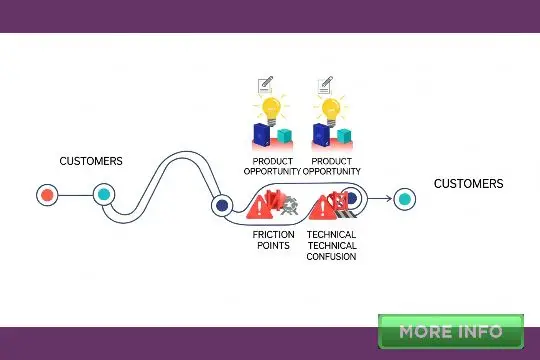
These roadblocks are the exact places where your digital product can offer the most value.
Every customer travels a path to reach their goal.
Map this journey from start to finish.
Where do they get stuck? Where is the manual labor required? Those specific points of friction are your biggest opportunities.
A small business owner might know how to market, but they struggle with the technical setup.
If you provide a template that automates that setup, you have found a product that sells itself.
Analyzing Market Demand: Is Your Solution a Vitamin or a Painkiller?
A vitamin is nice to have, but a painkiller is essential.
If you want to build a profitable business, aim to be the painkiller.
Validate your hypothesis by looking for where customers are already spending money to solve a version of their problem.
If they are paying for subpar alternatives, your superior product has a clear path to market dominance.
Phase 2: Strategic Prioritization and Risk Assessment
The Impact vs.
Effort Framework: Deciding What to Build First
Resources are finite.
Use an Impact vs.
Effort matrix to plot your product ideas.
Prioritize high-impact, low-effort tasks to build momentum.
This allows you to generate cash flow quickly, which can then be reinvested into more ambitious, high-effort products later.
Defining the V1: The Art of the Minimum Viable Product (MVP)
Your first version should not be perfect; it should be effective.
The goal of an MVP is to validate your core assumption with the least amount of development time.
Focus on the single feature that solves the biggest pain point.
Complexity can be added through iteration, but you cannot iterate on a product that was never launched.
Assumption Testing: Validating Your Business Idea Without Building a Prototype
Before writing a single line of code or designing a template, test your premise.
Use Social Media and Newsletters to gauge interest.
Ask your audience about their challenges.
If your content receives high engagement regarding a specific topic, you have empirical evidence that a demand exists.
This “pre-validation” ensures your building phase is focused on a guaranteed market.
Phase 3: Architecting the Solution—Product Categories that Scale
High-Utility Templates and Personal Systems (Notion, Figma, and Kortex)
Templates are the current gold standard for rapid scaling.
They provide immediate, tangible value.
By creating high-utility systems in Notion or design assets in Figma, you save your customers hours of work.
These products are easily repeatable and provide high profit margins because once they are built, the cost of replication is zero.
Deep-Dive Educational Products: Moving from Information to Transformation
Information is a commodity, but transformation is rare.
Do not sell “content”; sell outcomes.
If you are selling an educational product, build it like a curriculum.
Guide the user from point A to point B.
The more “homework” or practical exercises you include, the more your product moves from being a passive resource to a high-value tool.
Subscription Models and Newsletters: Building Recurring Revenue with beehiiv
Recurring revenue provides the stability every entrepreneur craves.
Platforms like beehiiv allow you to package content into premium newsletters.
This builds a predictable stream of income while deepening the relationship with your customers.
It turns your audience into a community, creating a sticky ecosystem that supports long-term growth.
Leveraging Generative AI to Automate Service-Based Products
Generative AI is a force multiplier.
Use it to automate repetitive tasks within your product delivery.
If you provide a consulting service, use AI to create standardized reports or frameworks that can be sold as products.
This allows you to scale your knowledge without increasing your labor hours, effectively decoupling your revenue from your time.
Phase 4: The Operational Backbone—Professionalizing Your Creative Business
Establishing a Secure Payment and Fulfillment Infrastructure (Stripe and Stan)
You cannot be a professional business if your payment process is amateurish.
Use reliable infrastructure like Stripe for payment processing and tools like Stan for seamless digital delivery.
These platforms ensure security and provide a frictionless checkout experience, which is essential for conversion optimization.
The “Boring” Essentials: Liability Insurance and Business Registration
Scalability carries risk.
As your business grows, so does your exposure.
Protect your assets by formally registering your business and obtaining appropriate liability insurance.
These “boring” steps are what separate hobbyists from entrepreneurs.
They allow you to operate with peace of mind, knowing your foundation is legally sound.
Protecting Your Community: Data Ownership, Privacy Policies, and Consent
Trust is your most valuable asset.
Be transparent about data usage.
Ensure that your privacy policies are clear and that you maintain ownership of your audience lists.
Never rely solely on rented land, such as Facebook or Google; your email list is your primary insurance against platform volatility.
Phase 5: Distribution Strategy and the Go-to-Market Motion
Designing a Landing Page That Sells the Transformation, Not the Features
Your landing page is a salesperson that never sleeps.
Focus on the emotional shift your product delivers.
Use clear, benefit-driven copy that speaks directly to the user’s pain.
Features are secondary; what matters is the result the customer gains after using your product.
The Trust Flywheel: Using YouTube and Social Media for Organic Growth
Use your organic channels to fuel the engine.
YouTube is a discovery engine, while Social Media serves as an ongoing conversation with your market.
Post content that demonstrates your expertise and addresses the very problems your products solve.
By the time a user clicks your link, they should already trust you to deliver the solution.
Email Marketing: Converting Lead Magnets into Long-Term Customers
The funnel doesn’t end at the sale.
Use your email list to provide ongoing value and introduce new products.
Convert leads into customers by offering a small, low-friction lead magnet.
Once they are inside your ecosystem, continue to nurture them.
Long-term customer value is driven by consistency, not constant selling.
Phase 6: Iteration and Post-Launch Scalability
Analyzing Product Performance: Using Analytics to Identify Churn
Data is the lifeblood of a product manager.
Look at your analytics to see where customers are dropping off.
Are they opening your emails? Are they completing the course? If they aren’t, the problem is likely in your product design or your messaging.
Use this feedback loop to fix bugs and enhance features.
Automating Customer Support and Feedback Loops
As you scale, manual support becomes a bottleneck.
Create self-service documentation, FAQs, and automated sequences that handle common inquiries.
Simultaneously, implement structured feedback loops.
Ask customers for reviews and suggestions after they’ve used your product.
This direct line to the user keeps your product roadmap aligned with real market needs.
Scaling Your Impact: Transitioning from a Single Product to a Product Ecosystem
The final stage of development is the transition to a suite of products.
Once you have a winning product, look for adjacent problems.
Build a “product ecosystem” where one product serves as a entry point, and another serves as an advanced deep-dive.
This strategy maximizes the lifetime value of your customer and cements your position as an authority in your niche.
Conclusion
Building a high-impact digital product is a journey that starts with the customer’s pain and ends with a scalable solution.
By abandoning the “passive income” myth and adopting the rigor of a professional product manager, you transform your creative work into a robust, revenue-generating business.
Remember that your primary goal is to solve specific, meaningful problems for your audience.
Everything else—from your choice of platform to your design aesthetic—is simply a means to that end.
Start by identifying the friction points in your industry.
Validate your assumptions through your existing content on social media and newsletters.
Build a lean, high-utility MVP that provides immediate value.
Finally, professionalize your operations and build a distribution flywheel that attracts, converts, and retains your ideal customers.
You now have the methodology.
The next step is execution.
Focus on the problem, iterate based on feedback, and keep your attention fixed on the transformation you provide.
This is how you build a product-led business that thrives in an increasingly crowded marketplace.
