
The digital economy is undergoing a structural shift.
For over a decade, the “info product” model—characterized by low-cost eBooks, pre-recorded video courses, and generic masterminds—has dominated the creator landscape.
However, this model is rapidly collapsing under the weight of AI-generated content and market saturation.
Consumers no longer value information for its own sake; when the cost of production for content drops to near zero, the premium shifts entirely toward implementation, verified data, and outcome-based systems.
To survive in 2024, creators must stop acting like digital hucksters and start operating like professional manufacturers.
Why Info Products Are Declining and How to Pivot is the core question for every serious entrepreneur today.
The AI Paradox: When Information is Free, Implementation is Premium
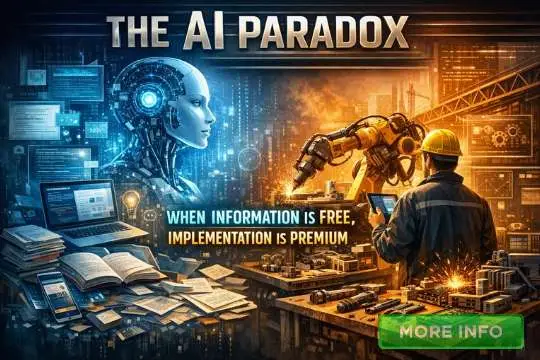
The explosion of generative AI has fundamentally altered the value proposition of digital assets.
In the past, creators sold “secret knowledge.” Today, that knowledge is available via a simple prompt.
As information becomes a commodity, the market has begun to treat information products as a cluttered, low-trust category.
People no longer value information just for itself.
When making content costs almost nothing, the value moves to how it is used, checked data, and systems based on results.
High-end consumers aren’t looking for another PDF; they are looking for systems that bridge the gap between knowing and doing.
The “Ballyhoo” Fatigue: Why Customers No Longer Trust Flashy Sales Pages

The era of aggressive, fear-based marketing—often defined by the industry as “ballyhoo”—is effectively over.
Customers are increasingly sophisticated; they recognize the patterns of high-pressure sales funnels and have developed a profound aversion to them.
This fatigue is a natural market correction.
When every sales page promises a “transformative journey” but delivers a series of uninspired videos, trust evaporates.
The modern consumer demands transparency and technical proof, not hyperbolic promises of passive income.
The “Data Siphon” Effect: Consumer Wariness Toward Low-Value Lead Magnets

The “freebie” economy—trading a massive amount of personal data for a five-page checklist—has created a cynical user base.
Consumers now view these “data siphons” as transactional irritants rather than valuable offerings.
When the “value” provided in a lead magnet is merely a recycled collection of tips found elsewhere, the brand equity of the creator is permanently damaged.
Digital security and the protection of personal information are now top-tier concerns for the savvy user, making your opt-in process a point of scrutiny.
The Digital “Recall” Framework: Identifying Class I, II, and III Content Failures
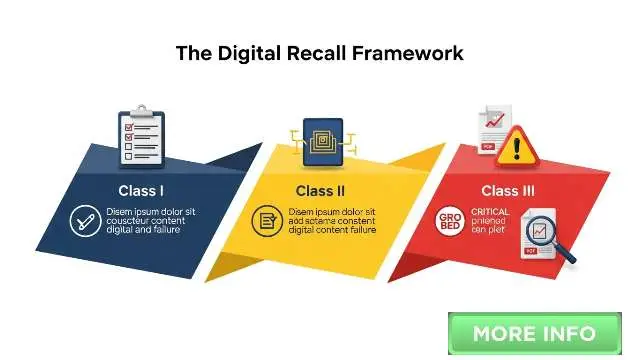
The Digital Recall Framework sorts digital product failures using traditional manufacturing quality control rules.
In the manufacturing sector, quality control is not optional.
If a food product has a hidden allergen, it faces a Class I recall.
This means the product could likely cause adverse health consequences.
We apply this logic to digital products:
- Class I recall: High risk of harm or severe misinformation.
- Class II recall: Temporary discomfort or confusion caused by the product.
- Class III recall: Minor labeling errors or formatting discrepancies.
Most creators currently ship “Class I” content without a second thought, ignoring the potential for real-world fallout.
Why Your Information Product Feels Like a “Violative Product” to the Modern Consumer
When you sell a course that lacks a robust support system, you are essentially shipping a “violative product.
” It is an unverified, untested asset that lacks the accountability of a regulated industry.
Whether you are dealing with a medical device or a piece of software, the principles of 21 CFR 7 are instructive.
If your content cannot withstand a rigorous audit, it is inherently unstable and destined for a market withdrawal.
Moving from “Cottage Food” Amateurism to Professional Digital Manufacturing
Many digital businesses now work like hobbyists.
They act like “cottage food” makers where rules are loose and there is little oversight.
Professionalizing your business means shifting away from this amateurism.
You need to set up a formal system for sharing and quality control.
This system should be as strict as a professional factory’s.
This transition involves understanding regulatory hygiene—from the Department of Agriculture standards to the requirements set by the Division of Hotels and Restaurants.
Moving Beyond the PDF: The Rise of the “Decision Tree” Methodology
The future of education is not passive consumption, but active decision-making.
Instead of static PDFs, creators should build decision trees—logical frameworks that guide a user through a specific problem based on their unique inputs.
This mimics the software development lifecycle, moving away from “theory” and toward “functionality.”
Building “Fillable PDF Workbooks” That Function as Software
To make your content indispensable, treat it as a utility.
A fillable, logic-driven workbook acts like a lightweight software application.
It requires the user to input data, make choices, and observe outputs.
This creates immediate time-to-value for the user, differentiating your product from the sea of passive content.
Case Study: Replacing Theory with a “Content Calendar Framework”
Rather than selling a theory on “how to blog,” provide a pre-programmed, interactive content calendar system.
By providing a template that is integrated with a workflow, you are selling an operational system, not just an information product.
Why a “Spreadsheet” is Worth 10x More Than an “Ebook”
A professional-grade spreadsheet is a tool of production.
It solves a specific, repeatable business problem.
When a customer pays for a spreadsheet, they are paying for saved time and reduced error—the two most valuable commodities in any industry.
The “Full Freezer” Approach: Providing Pre-Built Assets for Immediate Use
Think of your product library like a “full freezer.
” You aren’t just giving the user the recipe; you are giving them the prepared meal.
Provide the raw assets, the templates, the automations, and the check-lists.
The goal is to ensure the user can execute a task immediately after purchase without having to build the infrastructure themselves.
“Jumpstart” Kits: Reducing Time-to-Value for the End User
“Jumpstart” kits focus on the first 48 hours of a user’s experience.
By minimizing the “setup time,” you increase the likelihood of success.
This is the difference between selling a raw ingredient and selling a kit that is ready to be utilized in a professional workflow.
Solving the “Safety Net” Problem: Education That Mitigates Risk
High-stakes niches—such as legal, financial, or technical compliance—require a different level of rigor.
Education in these fields must act as a safety net.
It must be vetted, cited, and designed to protect the user from making catastrophic errors.
Lessons from “Texas DSHS” and “Cottage Food” Labeling: Teaching High-Liability Skills
When teaching high-liability skills, look at how regulatory bodies govern labeling.
They demand precision.
Your digital education should mirror this.
If you are teaching a skill that carries risk, provide the “labeling” that ensures the user is working within safe, defined parameters.
Why “Food Safety” and “Regulatory Rigor” are the New High-Ticket Niches
There is massive demand for experts who can teach others how to navigate complex regulatory landscapes.
Teaching others to follow rules like Florida’s farming standards or data privacy laws is a service people will pay well for.
This is because it is very important and valuable.
Why “Information” is Only the First Rung of the Value Ladder
Information is the hook, but it is not the business.
The business is the system you provide to ensure that information is applied correctly.
A hybrid approach allows you to scale: use information to acquire the client, and use the “implementation system” to retain them.
Combining “Swipe Files” with Group Implementation “Systems”
Swipe files are excellent “lead-in” assets, but they are insufficient on their own.
By pairing them with a group implementation system—where you provide live, audit-style feedback—you transform a static product into a dynamic, recurring revenue model.
The Transformation Model: Selling an Outcome, Not a Library of Videos
The transformation model focuses on a singular result.
If your customer wants to build a wholesale supply chain, don’t sell a course on “logistics.
” Sell the “Wholesale Launch System,” which includes the templates and audit checklists.
Moving from “Content Creation” to “Resource Manufacturing”
Begin making resources by collecting, checking, and organizing existing high-quality data.
In an age of noise, the “curator” who serves as a reliable filter is more valuable than the “creator” who adds more white noise.
The Role of the “Florida Wholesale Dealer” in the Digital Space: Curation as Value
Just as a Florida wholesale dealer must curate and track their inventory to avoid the distribution of a violative product, you must curate your resource hubs.
If you are authorized to import and sell saltwater products or manage a commercial vessel, you understand that your license and your Florida wholesale dealer number are your reputation.
Whether dealing with a Lampara Net Endorsement, a Purse Seine Endorsement, or navigating Saltwater Licenses for a restricted species, the rigor is the value.
Building “Sales Pages” That Focus on System Architecture, Not Hype
Your sales page should look like a technical manual, not a hype-filled advertisement.
Showcase the architecture of your system.
Explain how it handles errors, how it saves time, and how it is built to produce repeatable results.
Quality Control: How to Audit Your Digital Assets

To thrive in the current market, you must perform a self-audit of your business.
Take your entire product catalog and subject it to a “recall” test.
If a customer followed your advice and ended up with a “Class I” result—adverse consequences—would your brand survive the fallout? If the answer is no, your product is fundamentally flawed.
If you treat your digital business like a serious farmer treats crops or a medical device maker treats hardware, you stop being just a “creator.
” You become a partner in your client’s success.
Strip away the “ballyhoo” from your marketing and replace generic promises with specific, technical outcomes.
Conclusion
The decline of traditional info products is a necessary change in the digital economy.
The market no longer supports “information” as a viable product.
To succeed in 2024, entrepreneurs must shift to systems offering clear, verifiable results.
By adopting regulated manufacturing standards—focusing on quality, accountability, and reliability—you can leave behind the hype of the fading info-product industry.
You can build transformation-first operating systems, high-utility templates, or regulated niche assets.
The goal is to provide a strong solution that works like a professional tool.
Stop selling information; start creating value.
Your clients want a partner, not a guru.
Professionalize your operations, check your assets for risks, and build a lasting business.
