
The modern professional landscape is undergoing a tectonic shift.
For many, the nagging feeling of being trapped in a role that demands 60 hours a week but offers zero fulfillment is not a personal failure—it is a system design flaw.
This malaise is often compounded by the hedonic treadmill, where each promotion and salary bump simply raises the bar of your lifestyle costs, leaving your core happiness stagnant.
For Gen Z and burned-out professionals alike, the Great Resignation served as a necessary wake-up call: the traditional education system and corporate career tracks are often built on “systemic nurture” that prioritizes compliance over human potential.
To break this cycle, you need to stop guessing and start architecting your future with precision.
This article provides a technical framework for using large language models to audit your life, identify your true purpose, and design a career that supports your version of lifestyle design.
The Great Resignation and the Modern Search for Meaning
The “Great Resignation” was more than a post-pandemic trend; it was a clear signal that the workforce is demanding a new social contract.
People are no longer willing to trade their mental health for a cubicle.
Instead, they are seeking a Japanese concept known as Ikigai—a “reason for being” that provides a sustainable North Star for professional life.
This search for meaning is not about finding a “dream job” that magically solves all life’s problems; it is about achieving alignment between your daily output and your internal values.
Escaping the Hedonic Treadmill of the Traditional 9-to-5
The trap of the traditional 9-to-5 is the illusion of linear progress.
We are taught that hard work equals steady advancement, but we often find ourselves exhausted by the grind.
To escape, you must shift your perspective from being a permanent employee to becoming a strategist of your own life.
This requires an objective analysis of your habits and goals, stripping away the emotional weight of “what I should do” to focus on “what I am uniquely positioned to do.
“
Why Reflection Isn’t Enough: The Need for an AI-Powered Life Audit
Human reflection is notoriously biased; we tend to romanticize our successes and catastrophize our failures.
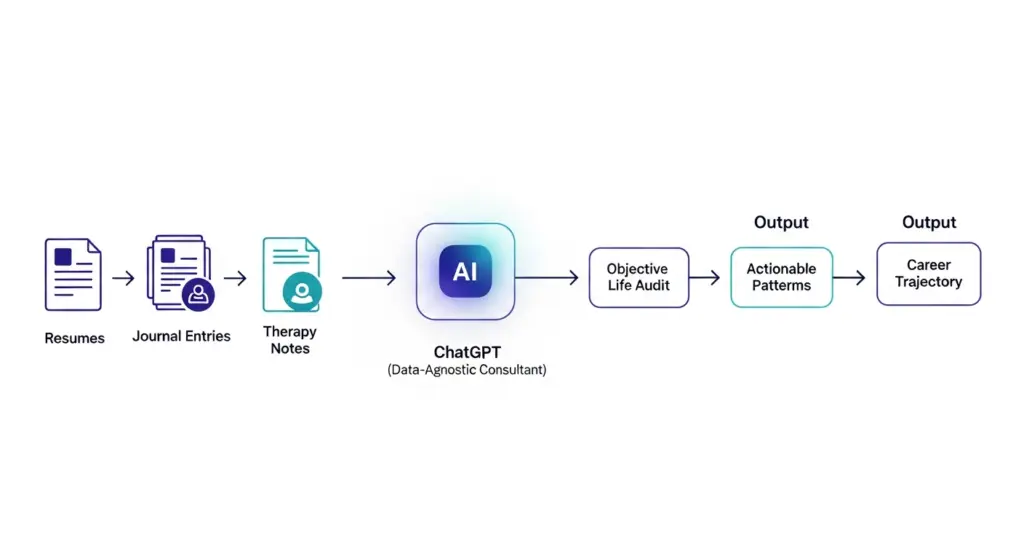
By using large language models like ChatGPT, you can perform an objective audit of your professional history.
By inputting your resumes, journal entries, and even “therapy minutes,” you allow the AI to function as a data-agnostic consultant.
This removes the emotional baggage and allows you to see clear, actionable patterns in your career trajectory.
Decoding Ikigai: The Four Pillars of a Sustainable Career
Understanding the Venn Diagram: Passion, Mission, Vocation, and Profession
The Venn diagram of Ikigai is often dismissed as a cliché, but when updated with modern data, it becomes a dynamic tool.
It requires you to synthesize four domains: what you love (Passion), what the world needs (Mission), what you are good at (Profession), and what you can be paid for (Vocation).
Using AI, you can identify which of these pillars is currently under-resourced in your life, allowing for a precise recalibration.
The Role of “Flow” and Mihaly Csíkszentmihályi in Professional Satisfaction
Mihaly Csíkszentmihályi’s research on “flow” is critical.
It describes the state of deep immersion where time melts away.
Your goal is to move your career toward a state of chronic flow.
If your current job offers no path to this state, it is statistically unlikely you will ever feel fulfilled, regardless of your compensation.
Why Longevity and Career Alignment Require Systems Thinking
True career sustainability requires systems thinking.
You aren’t just looking for a new job; you are designing a life that anticipates market volatility.
By applying regenerative development principles—where your career feeds your growth rather than depleting your resources—you create a feedback loop of continuous improvement and adaptation.
Moving from Subjective Feeling to Objective Data Synthesis
You likely have an intuitive sense that your career is “off.
” ChatGPT allows you to move from intuition to insight by aggregating your unstructured data—past projects, performance reviews, and failed side hustles—into a coherent narrative that reveals your genuine strengths.
How Large Language Models Identify Patterns in Your History
LLMs identify patterns with surgical accuracy.
By analyzing your resume and work history, the AI can detect if you are consistently drawn to high-impact, creative tasks or if you are habitually relegated to repetitive administration.
These patterns serve as the foundational data for your transition.
Treating Your Life Like a Neural Net: Finding Your Unique Value Proposition
Think of your life experiences as the training data for a neural net.
You are seeking to define your unique value proposition (UVP).
What do you offer that is the result of your specific, unconventional history? This is where your competitive advantage hides—in the intersection of your disparate skills.
Prompts to Extract Deep Insights from Your Resume and Journals
To start, provide your raw professional data to ChatGPT with this prompt: “Act as an expert strategist.
Review my resume and these journal entries.
Identify the recurring themes where I experienced ‘flow’ versus where I felt energy drain.
What is the common thread in the projects where I delivered the most value?”
Using AI to Identify “Flow” States and Hidden Creative Strengths
Ask the AI to cross-reference your “flow” moments with industry demand.
“Based on my identified strengths in [X] and [Y], what industries are currently undergoing massive growth and require these specific skill sets?”
Mapping Your Values: Defining What You Stand For in a Global Economy
Values are your filters.
Use the AI to pressure-test your principles: “Generate a list of 20 professional values.
Rank them by how essential they are to my long-term happiness. Help me identify which of my current daily tasks directly violate my top five values.”
Using ChatGPT as a Market Researcher to Find What the World Needs
Treat the AI as your market research department.
Ask it to analyze emerging gaps in fields like music tech startups or artist advocacy.
Identify where your unique background can solve real-world problems.
Identifying Monetizable Skills: Moving from Generalist to High-Value Specialist
Generalists are easy to replace; specialists with a unique “stack” of skills are not.
If you have programming skills mixed with a background in law or music, you have a rare niche.
Use ChatGPT to outline the certification or project-based path to becoming a recognized specialist.
Analyzing Emerging Trends in Remote Work and Regenerative Development
The shift toward remote work has decentralized the economy.
Use the AI to scout for opportunities that allow for location independence and focus on sustainable, long-term impact rather than short-term profit.
The “Career Architect” Prompt: Generating 5 Life-Design Blueprints
Once you have your data, use this: “Act as a world-class consultant. Based on my data, create 5 career blueprints. For each, include a 1-year transition plan, a risk-mitigation strategy, and a roadmap to scaling my value within 3 years.”
Testing for Alignment: Identifying Where Passion Meets Profit
Run your blueprints through a “feasibility test.
” Ask the AI to play devil’s advocate: “Critique these five plans.
Which one is the most susceptible to market disruption, and which one offers the most long-term stability?”
Using AI to Model Long-Term Career Sustainability
Simulate your career path five years out.
How does it evolve? Does it allow for the inclusion of new skills? A sustainable career is one that adapts, not one that is fixed.
Lessons from Music Law: Advocating for Your Value and IP
Consider the career of Christiane Kinney, a powerhouse Entertainment Attorney at Kinney Law.
She has navigated the complexities of music copyrights and high-stakes litigation like the Blurred Lines verdict.
She represents the pinnacle of the “multi-hyphenate” professional: balancing legal expertise with a deep appreciation for the arts, having worked with Grammy-winning artists and as a Celtic Musician herself.
Her work serves as a music law resource and a blueprint for how one can pivot from specialized legal work into broader areas like music tech startups and artist advocacy.
Her trajectory proves that you don’t just “quit”—you pivot by stacking high-value skills and protecting your intellectual property.
Applying Negotiation Tactics to Exit Your Current Contract Gracefully
When you choose to exit, do it with the precision of an attorney.
Use ChatGPT to draft a transition strategy that keeps professional bridges intact, framing your move not as a “quit” but as a deliberate evolution toward a niche you are uniquely qualified to occupy.
Building a Personal “Portfolio Career” to Hedge Against Market Volatility
In a volatile global economy, a “portfolio career”—where you have multiple streams of income and various projects—is the ultimate risk-mitigation strategy.
It allows you to stay in your flow state while insulating yourself from the total reliance on a single employer.
Overcoming the Psychology of Fear
Fear is often just a lack of data.
When you feel the impulse to retreat, return to your AI-generated insights.
Use the logic of William Green and Steven Leavitt in Wiser, Happier to ground your decisions in evidence-based, deliberative democracy principles—making choices that serve the “you” of the future, not just the “you” of today.
Understand the AI ethics involved in your own decision-making: ensure your model is built on your actual goals, not just an algorithm’s prediction of what you should do.
Conclusion
Finding your Ikigai is not a passive pursuit; it is a rigorous, data-backed project.
By shifting from the subjective, emotional frustration of a dead-end job to the objective, structural design of a “portfolio career,” you take control of your destiny.
Remember that this process is iterative.
Just as a neural net improves with more data, your understanding of your value will deepen as you test your hypotheses in the real world.
Whether you are inspired by the diverse expertise of leaders like Christiane Kinney or simply want to escape the hedonic treadmill, your transition begins with an honest audit.
Start today: feed your resume to the AI, define your values, and draft your first blueprint.
The goal is not just to quit your job—the goal is to build a life that you never want to resign from.
