
In 2026, the concept of “passive income” has undergone a necessary professionalization.
The era of “get-rich-quick” side hustles is fading, replaced by a sophisticated understanding of digital asset architecture.
True passive income is not about magic—it is about engineering.
It is the result of deliberate systems design where you build a machine once and harvest the output repeatedly.
This guide serves as your architectural blueprint for building a sustainable, scalable digital business that stands the test of time, market volatility, and technological shifts.
Rethinking “Passive” for 2026: The Shift from Side Gigs to Digital Assets
Why the Traditional Gig Economy is Evolving
The gig economy of the early 2020s was characterized by low-barrier, high-effort tasks.
Today, those entry-level roles are increasingly automated by AI.
Entrepreneurs who treat their income streams like disposable side gigs will inevitably face burnout.
The modern market rewards those who view their activities as the foundation of a long-term business.
We are moving away from manual trading of time for money and toward the creation of proprietary digital assets that gain value through compounding engagement and utility.
The “Machine” Metaphor: Building Systems That Outlast Trends
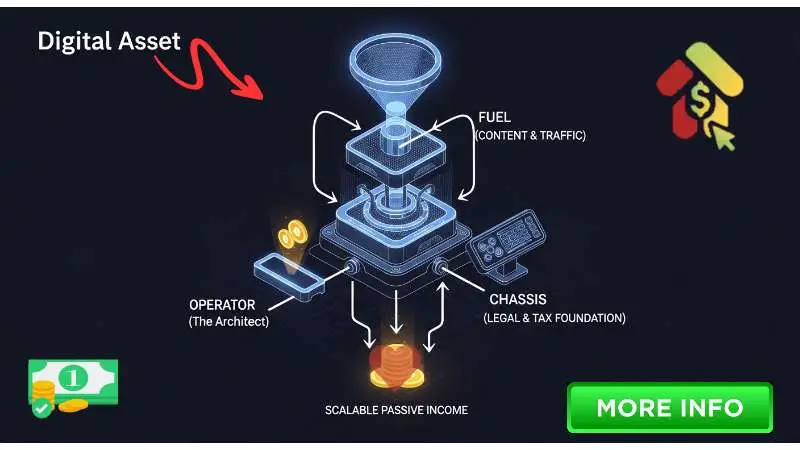
Think of your income stream not as a task, but as a machine.
A machine requires fuel (content), a chassis (legal/tax foundation), and an operator (you).
When you design for scale, you focus on modular systems where one component—such as an automated email sequence—handles thousands of customers simultaneously without requiring your active intervention.
This shift in mindset from “worker” to “architect” is the fundamental separator between hobbyists and successful digital entrepreneurs.
Setting Realistic Expectations: The Upfront Work Requirement
Let us be clear: “passive” is a misnomer for the initial 6 to 12 months.
Building a self-sustaining asset requires an intense period of active, front-loaded labor.
You must establish your market presence, refine your product, and troubleshoot your funnels before the system can run on its own.
Success in 2026 demands the patience to endure this “build phase” without immediate, massive financial gratification.
Phase 1: The Blueprint—Market Research and Idea Validation
Identifying Profitable Problems and Customer Demands
Profit is the reward for solving a problem.
Before launching a business, identify a specific, burning need within a niche.
Whether it is a software solution, an educational course, or a specialized digital product, your offering must provide measurable value.
If you cannot articulate the “why” behind a customer’s potential purchase, your income stream will fail to gain traction.
Conducting Market Research in an AI-Saturated Environment
In 2026, market research must go deeper than surface-level trends.
Use data analytics to track user sentiment across platforms, but supplement this with qualitative analysis of competitor reviews.
Identify what is missing from current market offerings.
If competitors are selling generic digital products, your opportunity lies in specialized, highly tactical content creation that fills the gap.
From Concept to Business Plan: Validating Scalability Before You Build
Scalability is the ability to grow your profit without growing your hours.
Before you commit resources, model your revenue potential.
If your business requires you to be present for every sale, it is not an asset; it is a job.
Use a lean business plan to outline your path to automation, ensuring that every digital product or service you design is inherently replicable.
Phase 2: Choosing Your Engine—High-Yield Digital Income Streams
The Creator Economy: Monetizing Expertise via Teachable, Udemy, and Gumroad
Platforms like Teachable and Gumroad allow you to package expertise into high-margin digital products.
By focusing on niche education, you capture high-intent customers who are willing to pay for direct results rather than vague information.
Digital Products: Leveraging Canva and Adobe for Micro-Brands and Etsy Stores
Etsy and Amazon provide the marketplace, but your branding provides the profit.
Use design tools like Canva to create high-quality templates, planners, or assets.
When you standardize your production process, you turn creative tasks into a manufacturing line, allowing your store to function as a 24/7 retail operation.
YouTube and Podcasting: Building Authority and Ad Revenue
A YouTube channel acts as your central hub for brand awareness.
By producing content that solves specific problems, you build trust with your audience.
This authority creates a dual income stream: ad revenue and the ability to convert viewers into customers for your higher-tier digital products.
Affiliate Marketing: Strategic YouTube Integration and LinkedIn Authority
Affiliate marketing is most effective when integrated into high-trust environments.
Do not treat it as spam.
Instead, recommend products that genuinely enhance your primary offerings.
By demonstrating expertise on LinkedIn or through detailed YouTube reviews, you convert your audience into a recurring stream of affiliate revenue.
E-commerce and Niche Micro-Brands: The Role of Shopify and Fulfillment Centers
For physical goods, utilize Shopify integrated with third-party logistics (3PL) providers.
By outsourcing fulfillment, you remove yourself from the physical movement of inventory.
This allows you to focus on the marketing and customer experience, which are the true drivers of long-term profit.
Phase 3: Establishing the Infrastructure—Legal and Tax Foundations
Business Registration and Regulatory Standards for Small Business Taxpayers
An engine without a chassis is just scrap metal.
Your legal structure—whether an LLC or a corporation—is the protective layer that safeguards your personal assets.
Registering your small business correctly is not just a regulatory hurdle; it is a prerequisite for professional credibility and banking access.
Navigating the 2026 Tax Landscape: Understanding Form 1040 and Schedule SE
Digital entrepreneurs must master the tax code.
You will likely file under Form 1040 with a Schedule C or SE to report your self-employment income.
Failure to account for the Self-Employment tax early in your business cycle is a common pitfall that ruins growth.
Advanced Filings: Managing Schedule F, Net Operating Loss, and Section 179 Deductions
As your business matures, utilize advanced tax strategies.
Section 179 allows you to write off equipment costs, while managing Net Operating Losses effectively can help you offset profits during your growth phases.
Always consult with a CPA to ensure you are maximizing these legal advantages.
Why Liability Insurance and Workers’ Compensation Matter for Digital Entrepreneurs
Liability insurance is an often-overlooked overhead expense.
Even digital-only businesses face risks like data breaches or copyright disputes.
Protecting your enterprise with the right insurance policy ensures that one unfortunate incident does not destroy your hard-earned assets.
Phase 4: Protecting the Machine—Cybersecurity and Risk Management
Safeguarding Your Digital Assets: Lessons from the Federal Bureau of Investigation (IC3)
The FBI’s Internet Crime Complaint Center (IC3) reports show that account takeovers are the primary threat to digital entrepreneurs.
Your business is only as secure as your weakest link.
Implement multi-factor authentication (MFA) across every single account, from your domain registrar to your payment processor.
Securing Home Networks: The Role of VPNs, Firewalls, and Residential Proxies
Working from home requires a fortified network.
Use a dedicated business VPN to encrypt your traffic and ensure your router is behind a robust hardware firewall.
These tools are the digital equivalent of a high-security lock on your front door.
Defending Against Identity Theft, Phishing, and Account Takeover
Phishing remains the most successful vector for attackers.
Train yourself and your team to identify social engineering attempts.
When your machine starts generating significant profit, you become a target.
Maintain regular backups of your digital assets in an offline, air-gapped location to ensure business continuity.
Phase 5: The Fuel—Audience Growth and the Superfans System
Moving Beyond Social Media Algorithms: The Priority of the Email List
Social media algorithms are ephemeral; your email list is your property.
Every follower on Instagram or TikTok is a rented audience, but your email subscribers are your owned channel.
Use social media to drive traffic toward your lead magnets, then nurture those leads via automated email sequences.
Content Strategy: Using a Content Calendar to Drive Organic Traffic
Consistency wins.
Use a content calendar to plan your YouTube, blog, and social media output.
By mapping your content to the customer journey, you ensure that you are consistently attracting new leads while providing value to existing followers.
The SPI Community Approach: Turning Casual Viewers into Superfans
A “Superfan” is a customer who purchases every product you release.
Foster this loyalty by creating a community around your brand.
Interaction, transparency, and high-touch support turn passive consumers into active advocates for your business.
Leveraging TikTok and Instagram for Top-of-Funnel Brand Awareness
Use short-form video platforms for discovery.
TikTok and Instagram are excellent for reaching new audiences who don’t yet know your brand.
Keep the content punchy and focused on one specific takeaway to maximize shareability and reach.
Phase 6: Automation and Maintenance—Turning the “On” Switch
Once the foundation is secure, the final phase is optimization.
Automate your customer service with AI chatbots, streamline your sales funnels, and use data analytics to prune low-performing products.
Your machine is now ready to run, provided you maintain its components through regular updates and periodic strategic reviews.
By institutionalizing these processes, you transform your labor into a repeatable, scalable asset that generates income long after you have moved on to your next project.
Conclusion
Building a digital machine in 2026 requires more than just creativity; it demands a disciplined, architectural approach to business.
We have moved beyond the “passive income” myth.
Success today is defined by your ability to build infrastructure that is compliant, secure, and automated.
To recap, your roadmap involves:
- Validation: Proving your market demand before building.
- Architecture: Choosing high-yield engines like digital products or niche e-commerce.
- Compliance: Hardening your business with correct tax and legal structures.
- Security: Protecting your assets from the growing tide of cyber-threats.
- Growth: Building a proprietary audience that you own through email and community.
The transition from a “side hustle” to a “digital enterprise” is difficult, but it is the only path to genuine financial independence in the modern era.
Your next step is to choose one high-yield stream, build a minimum viable product, and secure it with the legal and digital safeguards outlined here.
Do not aim for perfection; aim for a system that functions, scales, and protects.
The machine you build today is the foundation of your freedom tomorrow.
Begin the construction phase with intent, stay the course during the initial growth slog, and eventually, watch as your digital infrastructure works for you.
